
Buy homes that bring down your TA bill. Show cabinet the payback.
Viiyoo turns your programme's brief into a plan your officers can take to cabinet: the homes for sale that fit, the council's cash per home with the estimated grant and without it, the temporary-accommodation cost each home could avoid, and a simple payback. Your team reviews and releases every result, and reruns it as the market moves.
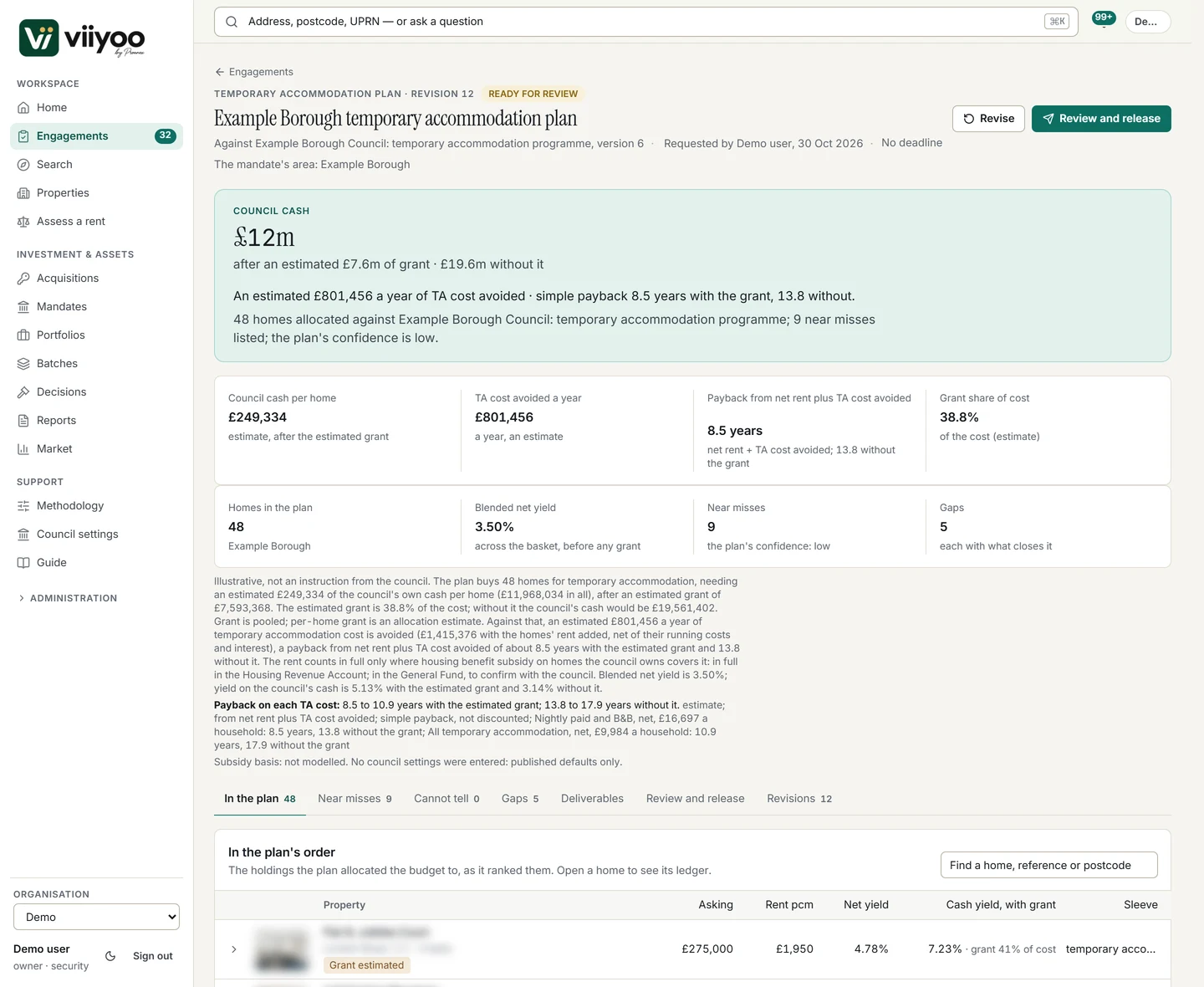
Real Viiyoo screen from a demo organisation, for a fictional council, using a London borough's published figures and no council settings: 48 homes within a £12 million budget, £249,334 of council cash per home after an estimated grant of 38.8% of the cost. Street names and photos are blurred.
- £801,456 a year estimated TA cost avoided
- 8.5 years simple payback with the grant, 13.8 without
Every household in nightly-paid TA is a cost the council carries each year.
A home bought can replace a placement
A home the council owns can house a household who would otherwise be in nightly-paid or B&B accommodation. The question is which homes, at what cash, paying back how fast.
Grant covers only part
LAHF and other grants pay a share of each home. The council's own cash is what cabinet approves, so it comes first, with and without the grant.
Cabinet asks why, home by home
Members, auditors and residents can ask why this home and not that one. Every figure is traced to its source and every left-out home carries its rule.
Council cash per home, the cost avoided, the payback. With the grant, and without it.
- Council cash per home, first. A temporary-accommodation plan opens with the council's own cash per home after the estimated grant, and the figure without it.
- The TA cost avoided, an estimate. From the council's own published return: net spend on nightly-paid and B&B placements per household, an annual average, not a nightly rate, with its year and source. If the published figure looks unusual, the plan says "to confirm with the council" and shows no saving. Your own figure replaces it.
- Payback, both ways. A simple payback, not discounted, with the estimated grant and without it, and a range across the council's TA costs. It assumes one bought home houses one household who would otherwise be in TA.
- Grant held to a share of cost. LAHF is estimated for each home and capped at a share of its cost, 60% to start: Viiyoo's starting point, not the scheme's rule. The council's cash covers what the cap takes off. A grant you state replaces the estimate.
- Yield, second. Blended net yield and yield on the council's cash come after, always beside the figure without any grant.
- Illustrative, and said so. Every pack is marked as illustrative, not an instruction from the council, and names what it has not modelled.
Listed homes in your areas, judged against your brief.
- Your criteria, in plain words. Paste the programme's brief. Viiyoo fills in the rules from it, quotes the words it used and lists what they did not say, for your team to check. A hard limit is never crossed. A target is reported, not enforced. A preference is shown on each home, and does not change the order.
- Every exclusion explained. Price cap, bedrooms, tenure, flood risk and Article 4, each home out with the rule it broke first.
- Bedroom size, against the LHA. A check against Local Housing Allowance sizing rules, not a judgement that a home suits a particular household.
- An estimate, or your own figure. A per-home LAHF estimate, or SHAP or your own grant at the figure you state, weighted by the chance of award you set. Neither is a confirmed award. Equity is shown with the grant and without it.
- The awkward listings handled. Auction lots recognised from the listing and handled by your auction rule; commercial and mixed-use listings not treated as homes; a listing with no house number screened against each home it could be, with "confirm the house number" as a condition.
- Rents against the benchmarks. Every home's rent compared with local rents and the LHA in force.
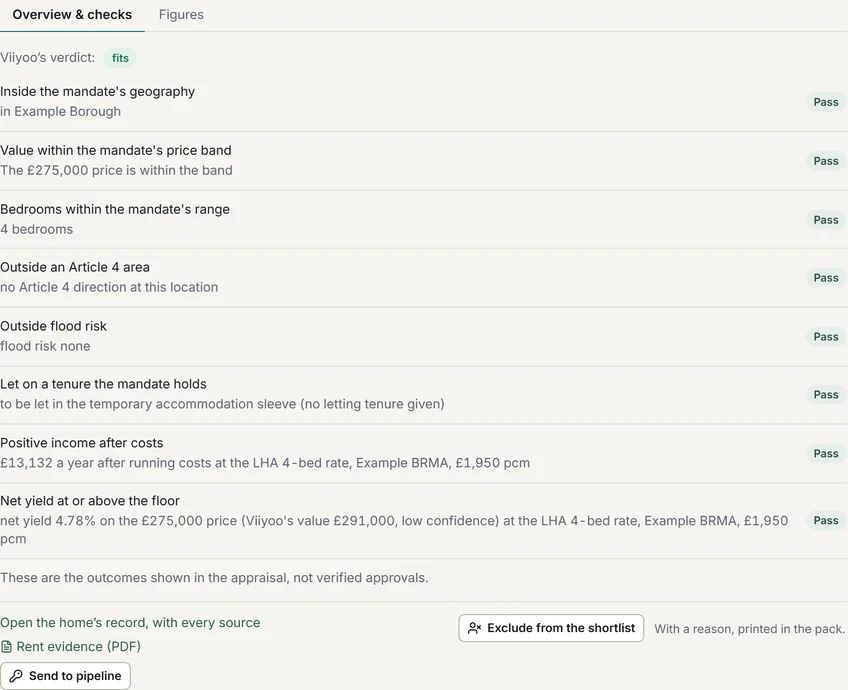
Each rule, its outcome and the figure behind it, at the rent the home would be let at.
1,408 homes for sale, 63 shortlisted, and why the others were left out.
Each of the 1,244 left out is counted under the first rule it broke, so a cabinet report can say why in one line, and any single home can be opened to show it.
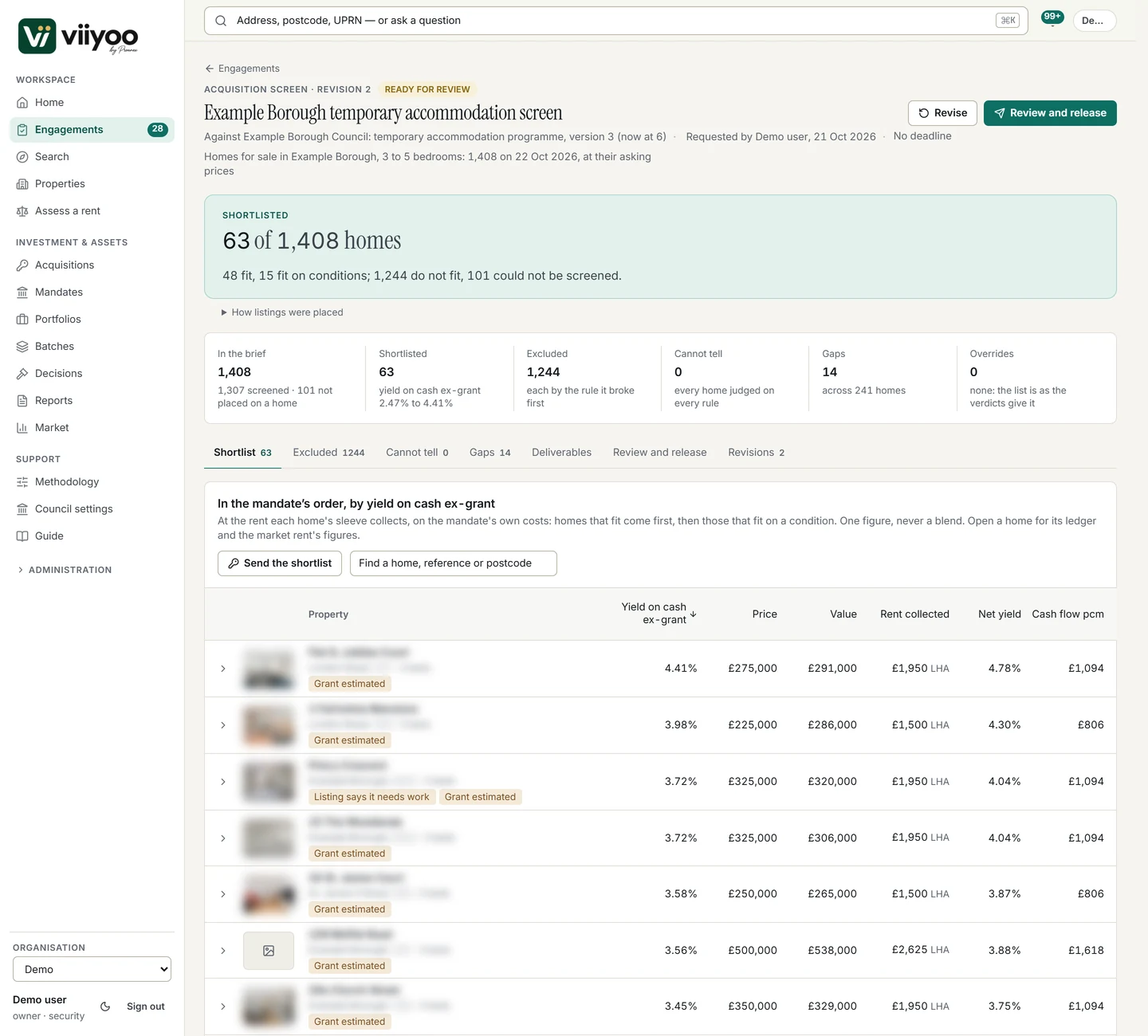
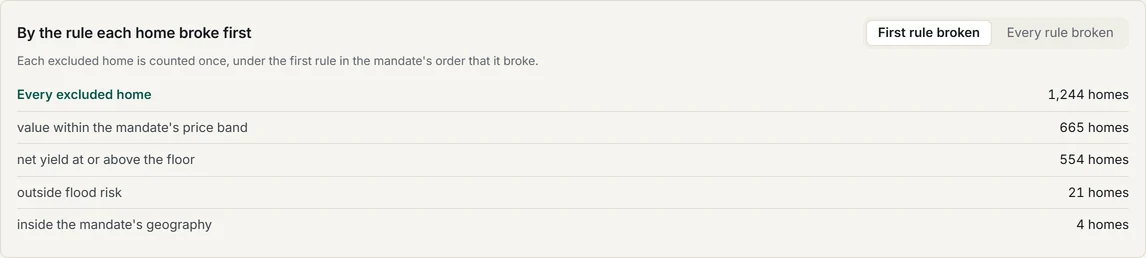
Real Viiyoo screens from a demo organisation, for a fictional council. Street names and photos are blurred.
Start with your own brief. Your team takes it from there.
- 01 · Brief
Your brief, as it is
The areas, the budget, the home sizes and any price limits, in plain words: an email, a committee paper or a programme document. We set it up with you as a mandate for your team to check.
- 02 · Screen
Every home for sale, screened
Viiyoo screens every home for sale in your areas against the mandate, estimates grant on each and uses your council's own published TA costs until you enter yours.
- 03 · Plan
A plan ready for cabinet
The homes that fit, council cash per home, the estimated TA cost avoided and a simple payback, with and without the grant, every exclusion explained, marked as illustrative until your officer releases it.
- 04 · Keep current
Your team runs it
Your officers rerun it weekly, monthly or when the rules change, and see what changed since the last plan. The first brief is set up with you, so the plan is already in your own workspace.
The same screen works for other acquisition programmes too: homes for other grant schemes, buybacks or regeneration. How deployment plans work
Ready for cabinet, audit and scrutiny.
The platform does the work; your own officer reviews it and releases it. Nobody at Viiyoo signs off your results.
Every figure sourced
Each figure links to its source and date. No figure comes from a language model: the arithmetic is tested code, and any drafted narrative is checked against it.
Released by your officer
Review, override with a reason, release. Overrides are printed in the pack with who made them, and nothing released changes afterwards.
A full audit trail
A decision log and an audit trail of every change, so the record behind a purchase can be produced long after it was made.
Your data stays yours
Client data held in the UK, single sign-on and SCIM on every plan, and your briefs and files never feed anyone else's results. Security.
What to expect, and what not to.
Does Viiyoo estimate temporary-accommodation costs?
Yes, as a starting point you can replace. For a temporary-accommodation plan, Viiyoo works a published cost per household from the council's own filed return: the latest year with a full set of quarterly counts, using net spend on nightly-paid and B&B placements over the households in them. It is an annual average, not a nightly rate, and it comes with its year and source. If the return looks unusual, the figure is marked "to confirm with the council" and no saving is shown until you enter your own. Viiyoo then shows an estimated TA cost avoided a year and a simple payback, with the estimated grant and without it, assuming one bought home houses one household who would otherwise be in TA. Your own placement, leasing and operating costs still make the real case.
Why is grant only part of each home's cost?
Viiyoo estimates LAHF with the published formula: a share of the council's median house price, capped, plus a fixed sum per home. On its own that does not depend on the home's cost, so for a home bought well below the median it could cover most of the price. The scheme sets no limit as a share of a home's cost, so the mandate sets one: for temporary-accommodation plans it starts at 60%, Viiyoo's starting point, not the scheme's rule, and can be changed or removed, with the council's own cash covering what the cap takes off. A home where the estimate would still cover 90% or more of its cost is held back to check the listing. It is an estimate, because the government does not publish each council's figure; a grant you state replaces it and is never capped.
Is a Viiyoo value a formal valuation?
No. Viiyoo's values come with a range and a confidence level and support a decision; where a RICS Red Book valuation is required, you still need one. How accurate they are.
Does Viiyoo give advice?
No. Viiyoo provides analysis and evidence, not advice. Your officers make and release every decision.
How do we start?
With your own brief. We set it up with you on your borough, so your team sees its own plan in Viiyoo before deciding. Plans are then monthly, with a 3-month initial term and then 30 days' notice, from £1,500 a month. Founding customers who sign before 31 December 2026 pay less for their first 12 months: Starter is £1,000 a month. See the plans.
Can you help with bespoke analysis?
Yes, separately from the platform. Our data consultancy takes on scoped work such as LHA benchmarking across placements or matching a stock file to UPRNs.
See it on your own borough.
Tell us your areas, your budget and the homes you need. We set up your first plan with you in Viiyoo: the council's cash, the TA cost avoided and the payback.